

In today’s competitive market, creating an advertising scenario for the automotive and motorcycle industry goes far beyond producing an attractive video. This scenario acts as a bridge between the engineering power of your product and the customer’s final purchasing decision. In an industry where products carry high value, audiences are not simply looking for visually appealing scenes; they seek a sense of trust, the excitement of speed, and a clear understanding of the key differences that persuade them to buy. A successful advertising video must capture the audience’s heart and mind within the very first seconds and guide them toward the final stage of decision-making.
In the automotive and motorcycle industry, advertising is not just a tool for raising awareness; it is the driving force behind a complex decision-making process. Designing a well-structured scenario helps your brand stand out effectively in a market crowded with competing advertising messages. The main reasons behind its importance include:
Advertising in the automotive and motorcycle industry differs fundamentally from other sectors due to the nature of the products themselves. In the table below, we examine the key characteristics that distinguish car and motorcycle advertising from other industries:
| Distinctive Feature | Impact on Scenario Writing |
|---|---|
| Emotional Engagement | Focusing on the audience’s lifestyle and aspirations rather than simply showcasing the product’s functionality. |
| Driving/Riding Experience | Conveying the pleasure of driving or riding and the sense of freedom through camera angles and music. |
| The Role of Sound, Motion, and Lighting | Using authentic engine sounds (exhaust notes) and dramatic lighting techniques to stimulate the senses. |
| Showcasing Technical and Visual Details | Presenting build quality in detail (interior materials, body design) alongside technical performance (acceleration, braking). |
After understanding the importance of scenario design in the automotive and motorcycle industry, the next step is to identify what truly makes a scenario “good.” In practice, the difference between an ordinary teaser and a genuinely impactful video lies in these very details of scenario writing. The most important characteristics of a successful advertising scenario for cars and motorcycles include:
Short and Focused
Audience attention spans are limited; the scenario should deliver the main message in a few concise scenes without unnecessary details or lengthy explanations.
Built Around a Single Core Message
The audience should not become confused by multiple messages. The scenario must revolve around one key idea or advantage, such as safety, speed, or luxury.
Tailored to the Target Audience
The tone, perspective, and storytelling style should match the target persona. A scenario for a youth-oriented sports motorcycle is completely different from one for a safe family car.
Adaptable for Both Real and AI Production
The scenario should be written in a way that allows it to be produced as a real video while also being adaptable for AI-generated production and multiple versions if needed.
Strong Opening, Climax, and Clear Call to Action
A good scenario follows a dramatic structure: it begins with a powerful hook, reaches an emotional or technical peak in the middle, and ends with a clear CTA that encourages the audience to take action, such as calling, booking a test drive, or making a purchase.
Just as following the right principles can make a campaign successful, a few common mistakes in scenario writing can easily weaken the impact of even a professionally produced video. Recognizing these errors helps prevent them during the planning and production stages:
In the previous sections, we discussed the importance of scenario design and the characteristics of a successful scenario. Now it is time to move into the practical side of the process. For an advertising scenario in the automotive and motorcycle industry to be truly result-driven and executable, it must be designed step by step based on a clear strategy. In the following sections, we will examine the most important stages of this process.
The first and most important step in designing a scenario is determining the goal of the campaign. Without a clear objective, it is impossible to craft the right message or create a scenario that ultimately delivers results. In the automotive and motorcycle industry, the following goals are the most common:
After defining the campaign goal, you need to know exactly who you are speaking to. Each audience group has its own concerns, language, and sensitivities. At this stage, understanding the audience persona helps you adjust the tone and content of the scenario more effectively.
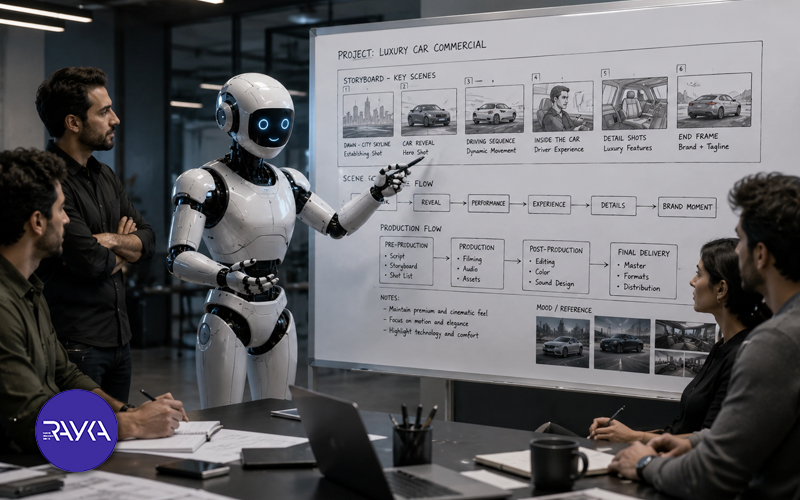
At this stage, you need to decide what is the single most important idea you want the audience to remember. The core message acts as the backbone of the scenario, and every scene should be built around it. The message can be based on one of the following themes:
After determining your core message, the next step is choosing the tone and overall mood, which essentially shape the personality and spirit of your video. Making the right choice at this stage determines how the audience will feel about your brand while watching the teaser.
For sporty products and younger audiences, an energetic and exciting tone filled with movement, fast rhythm, and high energy is the best way to convey a sense of power. In contrast, for premium brands and luxury vehicles, a sophisticated, calm, elegant, and minimalist atmosphere, focused on refined details rather than visual clutter, effectively communicates prestige and brand credibility.
If your target audience consists of specialists or technically minded individuals, the scenario should adopt a more technical tone and precise engineering language to showcase the technologies and build trust. However, for family-oriented products or trust-building campaigns, an emotional atmosphere centered around human stories and warm relationships tends to create a much stronger impact.
Modern atmospheres that blend technology with urban lifestyle, as well as minimalist concepts that communicate through powerful visuals and very little dialogue, are especially effective for innovative and forward-thinking brands.
Finally, you need to transform the message and tone into a visual narrative, meaning you define exactly what will be shown in each part of the video. For better structure and clarity, the scenario can be divided into the following sections:
For a scenario to keep the audience engaged until the very last moment in the highly competitive automotive and motorcycle industry, and motivate them to take action, it must follow a carefully engineered structure. In reality, a successful scenario is like a short story told within a few seconds: a story that needs a precisely designed rhythm to transform initial curiosity into a desire to buy.
In the following sections, we will examine the key components of this standard structure so you can understand how to manage each part of the video for maximum impact.
In today’s fast-paced world, you only have a few seconds to stop audiences from scrolling through social media. The hook is the opening and most valuable part of the scenario, designed to capture attention immediately without wasting a moment. This introduction can begin with the satisfying roar of an engine, a dramatic close-up of stunning body design details, or a fast and dynamic camera movement.
A short and thought-provoking sentence that directly addresses the audience’s concerns can also serve as the perfect hook to begin your narrative.
After capturing the audience’s attention, the main body of the scenario should focus on introducing the core of the story, your product or service. Instead of presenting a dry and exhausting list of technical specifications, the product should be shown in a real-life environment so the audience can imagine themselves using it.
This part of the narrative is the best opportunity to connect key features with practical experiences, showing how these features can improve the audience’s lifestyle or driving experience.
Every advertising scenario needs a key moment, a moment when the viewer fully understands the true value of the product. This section, known as the climax of the narrative, should focus on your strongest competitive advantage.
Whether it is the breathtaking acceleration of a car on a winding road or a close focus on the smooth suspension system and passenger comfort inside the cabin, the goal is the same: within these few seconds, your product’s superiority should appear undeniable and leave the audience impressed.
The ending of the video should never feel unfinished; instead, it must conclude with a clear and confident call to action (CTA). After seeing the product’s advantages and becoming emotionally engaged, the audience needs to know what their next step should be.
That is why the ending should guide them directly through phrases such as: “Book your test drive now,” “Visit our website to explore the technical details,” “Contact us for sales information,” or even an invitation to visit the showroom in person. A strong and direct ending like this minimizes the distance between a viewer and a potential buyer.
Following the discussion of scenario-writing principles and structures, this section explores some of the most common scenario patterns used in automotive and motorcycle advertising. These examples demonstrate how completely different storytelling approaches can be chosen based on the type of product, the brand’s positioning, and the characteristics of the target audience.
This style of scenario is entirely built around delivering an adrenaline rush. Here, words become less important and are replaced by thrilling engine sounds, fast-paced music, and rapid editing. The scenario may begin with a sudden burst of acceleration or the sound of brakes screeching through a sharp turn, while dramatic close-up camera angles showcase power and speed.
This strategy works exceptionally well for sports cars, high-performance motorcycles, and youth-oriented brands that want to communicate excitement, boldness, and speed.
The goal of this type of scenario is to create a deep emotional connection with the audience. Instead of focusing on horsepower and technical performance, the narrative revolves around meaningful life moments, for example, a father calmly driving his child to school or a memorable road trip along a peaceful route.
In this style, warm lighting, soft music, and visuals centered on smiles, comfort, and safety play the leading role. This scenario is the ideal choice for family cars, safety-focused products, and brands that want to build the image of a trustworthy companion.
In this type of scenario, power lies in simplicity and elegance. There is no visual clutter; instead, the video focuses on a few highly detailed and cinematic shots of the body lines, premium leather stitching, or the shine of the vehicle under studio lighting.
The music should feel calm, refined, and sophisticated, while the narration remains minimal yet impactful. This style is ideal for luxury vehicles, premium showrooms, and branding campaigns for high-end companies that want to communicate exclusivity, prestige, and distinction.
If your audience is looking for detailed information, this type of scenario is one of the most effective ways to persuade them. In this approach, you directly and transparently address the customer’s key concerns and questions.
By using animated infographics, showcasing engine components, or visually comparing cabin space and features with competitors, the scenario documents and highlights the product’s technical advantages. This style is especially suitable for emphasizing engineering strengths, positioning against rival brands, and introducing innovative technologies, allowing the audience to trust the product through logic and evidence.

In transportation industry scenario writing, cars and motorcycles cannot be approached with the same strategy. Each of these products has different audiences, purposes, and expectations, which means the core elements of an effective advertising scenario also change accordingly.
In car advertising, the narrative usually centers around family, comfort, and safety. In contrast, motorcycle advertising focuses more on excitement, freedom, and a distinctive lifestyle. Below, we explore the most important points of emphasis for each category.
In car advertising scenarios, the dominant approach is usually a combination of rational thinking and emotional reassurance. The audience often imagines themselves as the driver or as a member of the family, which is why the following elements should be strongly highlighted in the narrative:
In contrast, motorcycle advertising is usually created with a faster rhythm and a stronger focus on freedom and excitement. Motorcycle riders often see themselves as bold, different, or at least impatient with traffic and everyday limitations. As a result, the following elements become far more important in the narrative:
Today, brands creating automotive and motorcycle advertising teasers no longer rely only on the traditional approach of real-life filming. AI-generated videos have also become a serious and professional option. For a video production brand like Raykamah, understanding the difference between these two approaches, and how they affect the scenario, is extremely important.
From the very beginning, the scenario writer must know whether the final output will be “real,” “AI-generated,” or a combination of both. This decision directly influences the type of shots, the level of technical detail, the dialogue, and even the rhythm of the narrative.
In real-life video production, the audience experiences the actual product and its real environment. For industries such as automotive and motorcycles, where seeing the product up close and noticing details are highly important, this approach remains extremely effective. The main advantages of this method include:
AI-generated videos open up an entirely new level of creativity and production speed for brands. With this approach, you are no longer limited by locations, the number of vehicles available, weather conditions, or even traditional filming equipment. For a creative video production brand like Raykamah, this method offers major advantages, especially in diverse and multi-version campaigns.
To decide between real production and AI-generated video, or a combination of both, you can evaluate several key factors. The table below provides a quick guide for choosing the right production method based on the needs of the campaign:
| Campaign Condition / Requirement | More Suitable Choice | Brief Explanation |
|---|---|---|
| Showing the real product, body details, interior cabin, and test driving | Real Video | When the audience needs to truly “see and experience” the product, real production is the first choice. |
| Fast production speed and creating multiple versions for different platforms | AI Video | AI is more efficient for quickly launching campaigns or testing multiple creative ideas. |
| Focusing on visual creativity, unreal environments, or surreal storytelling | AI Video | AI is superior for creating imaginative worlds and scenes that are difficult or impossible to film in reality. |
| Main branding campaigns that require maximum trust and transparency | Real Video | For emotional connection and long-term trust-building, authentic brand visuals are more impactful. |
| Combining real product presentation with creative or graphic-driven scenes | Hybrid (Real + AI) | The ideal approach for using the strengths of both methods and creating differentiation in the market. |
| Limited budget but the need for professional and diverse visual output | AI Video or Hybrid | High-quality and visually varied results can be produced with lower overall costs. |
In the automotive and motorcycle industry, sales do not happen instantly; they are the result of intelligently guiding the customer through the buying journey. To turn your scenario from simple advertising content into an actual “sales tool,” its structure must align with the stages of the marketing funnel. Below are the key principles for designing a scenario that directly drives sales:
Full Alignment with the Sales Funnel
Your scenario must clearly understand which stage the audience is currently in. If the audience has only recently become aware of the brand (Awareness Stage), the scenario should focus on visual appeal and branding. If the audience is in the Decision Stage, the scenario should provide detailed information, product test footage, and answers to common concerns in order to push them toward finalizing the purchase.
Covering the Four Stages of the Customer Journey
Every successful scenario should guide the audience through these four stages—either within a single video or across a campaign series: Awareness: Introducing the product to the audience. Interest: Highlighting features that create desire for the product. Decision: Providing logical reasons and competitive advantages that justify choosing your brand. Action: Clearly directing the audience toward the final step, such as purchasing or booking
Single-Focus Strategy for Each Video
Avoid overloading the scenario with multiple messages. Each video should pursue only one clear objective. For example, a video designed for “awareness” should not become overloaded with complex financing details, while a video created to “close the sale” should not waste time on broad brand introductions. Focusing on a single goal keeps the message clear and can significantly improve conversion rates.
Anticipating Audience Reactions at Every Stage
A scenario writer should constantly ask: “What question will the audience have after watching this video?” A successful campaign anticipates those questions and answers them in the next stage of the customer journey—often through the next video in the sequence. This creates a connected content chain that gradually guides the audience step by step toward your dealership or website.
Choosing a strategic partner for advertising content production in highly competitive industries such as automotive and motorcycles is a decision that directly impacts both your return on investment and your brand image. By combining a deep understanding of the automotive market with artistic creativity and technical expertise, the Raykamah Advertising Agency creates a unique path for your brand’s growth. The following points explain why we are the preferred choice for leading brands.
At Raykamah Advertising Agency, we are not limited to traditional production methods. With professional teams specializing in real-life filming alongside creative AI experts, we are able to choose the most suitable visual style for your brand identity. This hybrid capability allows us to create visuals that are simultaneously realistic, modern, and visually striking.
Creating scenarios for this industry requires specialized knowledge. The team at رایکاماه Advertising Agency understands the technical expectations, emotional triggers, and lifestyle preferences of automotive audiences. We design scenarios that truly speak the customer’s language.
We know how to transform technical product features into engaging and persuasive narratives that remain memorable to the audience.
At Raykamh Advertising Agency, we understand that visual beauty alone is not enough. Every frame and every line of dialogue in our scenarios is engineered around a specific campaign objective, whether it is brand awareness or direct sales conversion.
Our goal is always to maximize engagement and achieve the highest possible conversion rates for your brand.
For us, video production is not the final goal, it is part of a larger long-term strategy. From concept development to final editing, Raykamah Advertising Agency approaches every project with a strategic understanding of your brand.
We do not simply deliver a high-quality video; we act as your creative partner and consultant throughout the campaign process, ensuring that your advertising message strengthens your brand value, credibility, and market positioning.
To better understand how a written script can be turned into a compelling visual piece, we invite you to watch Raykamah Advertising Agency’s teaser design and production project for the Haval brand. In this project, our main focus was on combining the “elegance of intelligent design” with “powerful performance” to convey a sense of trust and the brand’s technological edge to the Iranian audience.
Designing a successful advertising scenario for the automotive and motorcycle industry goes far beyond writing a simple script. In reality, you are creating a persuasive journey that guides the audience step by step toward making a purchase decision. As we explored throughout this article, success in this field depends on your ability to simultaneously communicate excitement, trust in quality, and the superiority of your product’s competitive advantages.
It is important to remember that the effectiveness of a professional teaser directly depends on a deep understanding of the product, accurate analysis of audience behavior, and clear campaign objectives.
If you are ready to create a memorable scenario for your automotive or motorcycle brand, one that stays in the audience’s mind and strengthens your sales process, the specialists at Raykamh Advertising Agency are here to help. Contact us today for professional consultation and a fully customized campaign scenario tailored to your brand.